


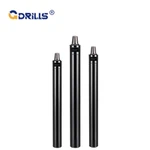
Core Barrels
Professional Core Barrels Supplier
Gdrills provides a complete range of wireline core barrels and conventional core barrels, including BQ, NQ, HQ, PQ and etc, designed to perform in various formations - from soft sediments to extremely hard and abrasive rock layers. Backed by strong quality control, customizable options, fast delivery, and dedicated technical support, Gdrills stands as a trusted partner for drilling companies seeking consistent performance and long-lasting reliability in their coring operations.


Why Choose Us
Our certificates
We have established a complete quality management system and passed ISO9001 quality management system certification and ISO14001 environmental protection management system certification.
Production market
Our products have been used in many large-scale mines and tunnel projects, and our business scope covers Africa, the Middle East, Central Asia, South America, Australia and other regions.
Our services
In the pre-sales stage, our team of experts will recommend the most suitable products according to the needs of customers and provide detailed technical consultation. During the sales period, we ensure timely delivery and provide installation guidance. For after-sales, we provide long-term technical support, warranty services and spare parts to help customers maximize the use of products and get reliable maintenance during use.

High core recovery rate: Core barrels are designed to protect the core during drilling and extraction, ensuring continuous, intact core samples. This helps geologists obtain accurate geological data for analysis.
Improved drilling efficiency: A well-designed core barrel system allows smooth inner tube movement and reduces the risk of core jamming, resulting in faster core retrieval and less downtime.
Professional Wireline Core Barrels for High Core Recovery
Optimize your mineral exploration with Gdrills’ high-precision core barrels. Engineered for the toughest geological conditions, our wireline systems ensure maximum core recovery, minimal sample disturbance, and faster tripping speeds. Fully compatible with industry-standard Q, T2, and T6 series.
Dimensions & Specs
|
Standard |
Hole Diameter (mm) |
Core Diameter (mm) |
Description |
Recommended Rock Type |
|
BQ |
60.0 |
36.4 |
Standard Wireline |
Hard & Competent Rock |
|
NQ |
75.7 |
47.6 |
Most Popular Choice |
All Formations |
|
HQ |
96.0 |
63.5 |
Large Diameter Core |
Fractured / Medium Hard |
|
PQ |
122.6 |
85.0 |
Extra Large Core |
Soft / Unconsolidated |
|
NQ3 |
75.7 |
45.0 |
Triple Tube System |
Very Broken / Sensitive |
Types of Core Barrels
Conventional core barrel: The conventional core barrel is normally made of a metal tube with a bit on the bottom that is attached to a drill string. Core drills are larger than most drill bits and are typically 3-12 inches in diameter. Unlike other core barrels, the conventional core barrel secures the core with a core catcher.
Triple core barrel: The triple core barrel contains three independent core sections. These sections help in increasing the amount of core recovered in a single drill hole. This core barrel type also provides useful information on the stratigraphy of a particular location.
Flexible core barrel: The flexible core barrel has a rubber or plastic liner that is used to gather geological information in undisturbed formations. This core barrel type has a flexible side so that it can gather information in geological formations with curves and bends.
Wireline coring barrel: The wireline coring barrel uses a thin wire to retrieve the core. A winch system then lowers and raises the barrel in the drill hole. This core barrel type allows for continuous core retrieval without having to stop the drilling process.
Features of Core Barrels
|
Item |
Contained Models |
Feature |
|
LTK core barrel |
LTH48, LTK60 |
Designed for high-speed, wireline drilling Good core recovery in fractured formations Used in Exploration drilling and Geo-technical investigations Shallow to medium-depth drilling |
|
TT diamond barrel |
TT46, TT56 |
Improves penetration rates while maintaining core integrity Good for soft to medium-hard formations Used in Mineral exploration and Environmental and geo-technical drilling Core sampling in weak formations |
|
T2 conventional core barrel |
T2-46, T2-56, T2-66, T2-76, T2-86, T2-101 |
Suitable for conventional rotary drilling Works well in fractured and consolidated formations Used in Geo-technical and site investigations, exploration drilling in softer formations Shallow to medium-depth drilling |
|
T6 core barrels |
T6-76, T6-86, T6-101, T6-116, T6-131, T6-146 |
Double-tube design for better recovery Suitable for medium to deep drilling used in Geotechnical and mineral exploration Medium-depth drilling in fractured or loose formations |
|
T6S diamond barrels |
T6S-76, T6S-86, T6S-101, T6S-116, T6S-131, T6S-146 |
Ideal for highly fractured or soft formations Same diameter range as T6 but with an extra inner tube Protects delicate core samples from damage Highly fractured formations and soft rock drilling |
Application of Core Barrels
Geological sampling: Core barrels are extensively used in the field of geology for sampling subsurface materials. Core barrels enable geologists to obtain rock or soil samples and gain insights into the composition, structure, and stratigraphy of the earth's subsurface.
Mining exploration: Core barrels play a vital role in mining exploration. Mining companies can evaluate the quality and quantity of mineral deposits, determine the feasibility of mining operations, and make informed decisions regarding mine development and resource management by using core barrels to conduct drilling and obtain representative samples of mineral ore.
Civil engineering projects: Core barrels are essential tools in civil engineering. Core samples provide valuable information about soil bearing capacity, rock properties, and geological conditions.
Environmental monitoring: Core barrels contribute to environmental monitoring and assessment. By obtaining sediment or soil cores from contaminated sites or wetlands, researchers can evaluate the extent of contamination, study sediment deposition patterns, and monitor environmental changes.
Comprehensive Core Barrel Systems
- Wireline Core Barrels (Q Series)
The deep-hole exploration industry standard. BQ, NQ, HQ, and PQ sizes are available.
For medium-to-hard rock formations, the double tube system is perfect.
For fragile, cracked, or shattered formations, a triple tube system is necessary to guarantee 100% core integrity.
- T2 & T6 Series (Conventional)
Intended for shallow geotechnical studies and surface drilling. These barrels with thin walls offer affordable solutions for a range of rock hardness levels.
- Jet-Type Core Barrels
Specifically designed for sandy, loose, or soft formations where the sample can be readily removed by water pressure.
Length: Core barrels have lengths that range from 600 mm (2 ft) to 1,200 mm (4 ft) or more. Short core barrels, usually below 600 mm (2 ft), tend to be easier to control and affordable.
Diameter: The diameter of core barrels can vary, usually between 25 mm and 200 mm. An ideal core barrel diameter can affect the volume of material or sample retrieved. It can also influence the precision and stability of the drilling operation.
Material composition: Core barrels are manufactured from different materials, such as tungsten carbide, diamond, and steel, to affect their performance and durability. For instance, steel core barrels are often used for geology exploration drilling, soil investigation drilling, and water well drilling.

Packing and Shipping of Core Bits
|
Packing |
Cartonbox, plastic bag, wooden case. |
|
Shipping |
Shipped by road, sea, rail |
Q: What are core barrels used for?
A: Core barrels are used to extract rock and soil samples from deep within the earth during geological and geological engineering drilling operations. The samples are crucial for conducting soil composition analysis, geological mapping, mineral exploration, environmental assessments, and other related studies.
Q: What are core barrels made of?
A: Core barrels are typically made of high-strength steel to ensure durability and performance during drilling operations. Some core barrels may also be coated with tungsten carbide to enhance their wear resistance and extend their lifespan in demanding drilling conditions.
Q: How does a core barrel work?
A: core barrel consists of a cylindrical hollow metal barrel, inner core bit, drilling tool, and a wireline or flush pipe for recovery system. While the core bit cuts through the target material, the core is retained in the barrel.
Q: What types of core barrels do you supply?
A: We provide both wireline core barrels (BQ, NQ, HQ, PQ) and conventional core barrels in multiple sizes to suit different drilling systems and formation conditions.
Q: How do I choose the correct core barrel size?
A: Selection depends on drilling depth, formation hardness, required core diameter, and rig capacity. Our team can recommend the best type and size based on your project details.
Q: What is the difference between single-tube, double-tube, and triple-tube core barrels?
A: Single-tube core barrels are used for simple drilling in soft, stable formations.
Double-tube core barrels are used to improve core recovery, suitable fore medium-hard or fractured formations.
Triple-tube core barrels are used to provide macimun core protection and is ideal for highly fractured, weathered, or crumbly formations.
Q: When should I choose a Triple Tube system over a Double Tube?
A: When working with coal, clay, or extremely fragmented rock, Triple Tube (such as NQ3) is essential. The extra split inner tube ensures an undisturbed sample by shielding the core from mechanical friction and flushing water.
Q: Are Gdrills core barrels compatible with other wireline systems?
A: Yes, our BQ, NQ, HQ, and PQ systems are manufactured to meet global ISO standards, making them 100% interchangeable with existing wireline equipment.