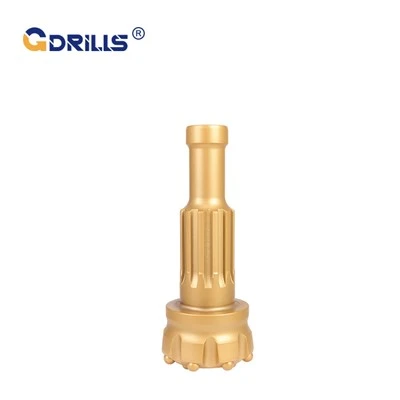
Retract button bits are a type of drill bit specifically designed for top - hammer drilling applications. They are characterized by their retractable buttons, which can retract into the bit body under certain conditions. This design feature offers several advantages. For example, it helps to prevent the buttons from being damaged during the drilling process, especially when encountering hard rocks or irregular formations.
The main components of retract button bits include the bit body, the buttons, and the retracting mechanism. The bit body is usually made of high - strength steel, which provides the necessary structural support. The buttons, on the other hand, are typically made of tungsten carbide, a very hard and wear - resistant material. The retracting mechanism allows the buttons to move in and out of the bit body, enabling them to adapt to different drilling conditions.
We offer a wide range of retract button bits, such as the Retract Drill Bit for Quarrying T45, R32 Retractable Drill Bit, T51 Retract Button Bit for Broken Rock, Heavy Duty Retrac Bit Button, and Bit Button Manufacturer T38 Retrac. Each of these products is designed to meet specific drilling requirements in different environments.
Characteristics of Ceramic Material
Ceramics are a group of materials known for their hardness, brittleness, and low thermal conductivity. They are widely used in a variety of industries, such as construction, electronics, and automotive, due to their excellent mechanical and electrical properties. However, these same properties also make ceramic drilling a challenging task.
The hardness of ceramics makes it difficult for drill bits to penetrate the material. Traditional drill bits may quickly become dull and lose their cutting ability when drilling through ceramics. Moreover, the brittleness of ceramics means that there is a high risk of cracking or chipping during the drilling process. This requires the drill bit to have a precise cutting edge and a proper drilling strategy to minimize damage to the ceramic workpiece.
Technical Analysis of Using Retract Button Bits for Ceramic Drilling
First of all, the tungsten - carbide buttons on retract button bits are extremely hard. Tungsten carbide has a high hardness rating, which allows it to effectively cut through the hard ceramic material. The sharp edges of the buttons can break through the ceramic surface with relative ease, compared to some other types of drill bits. Secondly, the retractable feature of these bits can be beneficial in ceramic drilling. During the drilling process, if the drill bit encounters a hard inclusion or an uneven area in the ceramic, the retracting buttons can adjust to the changing conditions. This helps to prevent over - stressing the drill bit and reduces the risk of the buttons breaking off. As a result, the drill bit can maintain a more stable cutting performance, reducing the likelihood of cracking the ceramic workpiece.
One of the main limitations is the bit design. Retract button bits are mainly designed for rock and soil drilling, where the material is generally more porous and less brittle than ceramics. The aggressive cutting action of these bits, which is suitable for rock drilling, may cause excessive chipping on the ceramic surface. The high - impact force generated during the top - hammer drilling process may also lead to micro - cracks in the ceramic, even if the bit can penetrate the material. Another limitation is the heat generated during drilling. Ceramics have low thermal conductivity, which means that heat generated during the drilling process is not easily dissipated. Retract button bits rely on a high - speed and high - impact drilling method, which can generate a significant amount of heat. Excessive heat can cause thermal stress in the ceramic, leading to cracking and other forms of damage.
Practical Considerations for Using Retract Button Bits in Ceramic Drilling
Drilling Parameters. When using retract button bits for ceramic drilling, it is crucial to adjust the drilling parameters properly. The rotational speed should be relatively low to reduce the heat generation and the impact force on the ceramic. A slow and steady feed rate is also recommended to prevent chipping and cracking. For example, a rotational speed of around 100 - 300 RPM and a feed rate of 0.01 - 0.05 mm per revolution may be appropriate in some cases.
Lubrication and Cooling. To dissipate the heat and reduce friction during the drilling process, proper lubrication and cooling are essential. A coolant or lubricant can be applied to the drilling area to keep the temperature down. Water - based coolants are often used in ceramic drilling, as they are effective in heat dissipation and are also environmentally friendly. However, it is important to ensure that the coolant does not contaminate the ceramic workpiece.
Workpiece Fixation. The ceramic workpiece should be firmly fixed during the drilling process. Any movement or vibration of the workpiece can increase the risk of chipping and cracking. Using a vice or a clamping device to secure the ceramic piece in place can help to ensure a more stable drilling process.


Case Studies
There have been some case studies in the industry regarding the use of retract button bits for ceramic drilling. In one case, a construction company was tasked with drilling holes in ceramic tiles for a bathroom renovation project. They initially tried using traditional drill bits, but they experienced frequent bit breakage and significant chipping on the tile surface.
Then, they decided to test our R32 Retractable Drill Bit. By adjusting the drilling parameters and using a water - based coolant, they were able to achieve better results. The retractable buttons on the bit helped to adapt to the hard ceramic material, and the overall chipping was reduced. Although there were still some minor issues, such as a small amount of heat - related cracking in some areas, the performance was significantly improved compared to the traditional drill bits.
In conclusion, retract button bits can potentially be used for ceramic drilling, but there are both advantages and limitations. The hardness of the tungsten - carbide buttons and the retractable design offer some benefits in terms of cutting through the hard ceramic material and adapting to changing drilling conditions. However, the bit's design, the heat generation during drilling, and the risk of chipping and cracking are significant challenges that need to be addressed.
By carefully adjusting the drilling parameters, using proper lubrication and cooling, and ensuring firm workpiece fixation, it is possible to use retract button bits to drill ceramics with reasonable results. As a supplier of retract button bits, we are committed to providing high - quality products and technical support to help our customers solve their drilling problems.
If you are interested in our retract button bits and want to discuss the possibility of using them for your ceramic drilling projects, please feel free to contact us. We are more than happy to engage in procurement discussions and offer customized solutions based on your specific needs.