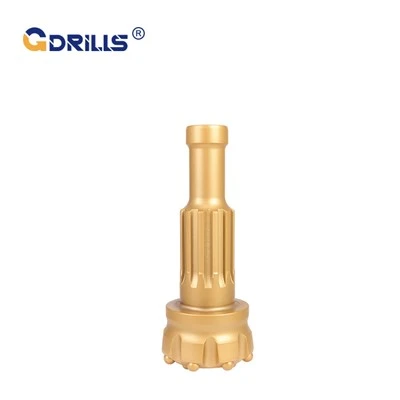
When you walk into a drilling or mining operation site, the tools on the workbench might look similar at first glance-small, sharp, and designed to carve through rock. But for anyone who's spent hours troubleshooting borehole accuracy or part replacement downtime, there's a critical distinction that separates a drill bit from a reaming bit: one is built to start a hole, and the other is built to get that hole right. As a supplier of high-performance reaming bits, I've seen firsthand how mixing these tools up can derail a project-from delayed timelines to costly material waste. Let's break down the science, purpose, and real-world use cases of each, so you never have to guess which one you need.
First, let's start with the drill bit. Drill bits are engineered for penetration: their primary job is to create a hole, often in a single pass, by fracturing rock, concrete, or other hard materials with sharp, concentrated cutting edges. For top-hammer drilling, a method used in construction, mining, and quarrying to bore holes for blasting or structural anchoring, drill bits are sized just right to create the initial bore, with a diameter tailored to the hole's starting specifications. But here's the catch: when you're drilling at depth, the initial bore isn't always uniform. The rock's hardness can shift, the drill string might wander slightly, and vibration can cause the hole to veer off course or have irregular walls. That's where reaming bits come in. Reaming bits don't create the hole-they refine it. Their core function is to enlarge, smooth, and straighten an existing borehole to meet precise dimensional tolerances. They're like the sandpaper to the drill bit's saw, finishing the work that the initial penetration couldn't nail.
Let's dive deeper into the design differences that make these tools so distinct. Drill bits, especially guide button bits like the T45 Guide Button Bit for Stable Boring Performance, have a compact, focused cutting structure. Their buttons (the hardened carbide tips that do the cutting) are arranged in a tight pattern at the bit face, optimized for breaking rock material forward as the bit rotates. This front-loaded design keeps the drilling force concentrated on the tip, allowing the bit to bite into the rock quickly. But that tight arrangement means the drill bit's outer edges don't extend much past the center-so the sides of the hole aren't cleaned up, and the diameter might be slightly smaller than intended, or inconsistent along the hole's length.
Reaming bits, by contrast, have a different cutting layout. Instead of focusing all cutting power forward, reaming bits have larger, more spaced-out cutting elements along their outer circumference. Some, like the Reaming Bit with Replaceable Pilot Adapter, even have a smaller pilot section at the front that guides the bit along the existing hole, while the outer reaming blades take care of sizing and smoothing the walls. This design ensures that as the bit rotates, it removes material from the sides of the existing bore, not just the front. The result is a hole that's not just bigger, but uniform in diameter, with smooth walls that prevent future issues like casing binding or fluid flow problems.
I've seen how this design difference plays out in real projects. A few years back, a mining customer called me in a panic: their initial drill bit had created a 100-meter borehole, but the diameter was 5mm wider at the bottom than at the top, making it impossible to lower their production casing. We sent them a reaming bit-specifically our 12 Degree Taper Reaming Bit R35, designed for precise sizing in deep, narrow bores-and after one pass, they had a perfectly uniform hole. The drill bit had done its job of getting the hole started, but it couldn't fix the wandering that happened at depth because it wasn't built to adjust or refine the sides. That's the key: drill bits are for initiation, reaming bits are for calibration.
Another critical difference is material and durability. Drill bits need to withstand constant, focused impact at the tip, so their carbide buttons are often shaped to handle forward force. Reaming bits, however, have to handle both rotation and side loading as they scrape against the hole walls. That means their outer cutting elements are made with wear-resistant alloys that can stand up to friction over longer periods. A drill bit might wear out after a few dozen meters of drilling, but a high-quality reaming bit can last for hundreds of meters of continuous reaming work. This is why choosing the right tool for the job isn't just about function-it's about cost. Using a drill bit when you need a reaming bit won't just give you an irregular hole; it'll wear out your tool faster, leading to more replacements and higher operating costs.
Let's talk about when to use each tool, because that's where many users get confused. If you're creating a new borehole from scratch-say, a blast hole for a quarry, or a pilot hole for a foundation-you'll start with a drill bit. If you're drilling a hole that needs to be a specific diameter, or if you need to correct a hole that's become off-center or irregular, you'll reach for a reaming bit. Some operations even combine both steps: first drill with a drill bit to get the initial hole, then ream with a reaming bit to perfect it. For example, in horizontal directional drilling, reaming bits are used to enlarge the pilot bore after the initial drill pass, creating a path large enough for pipe installation. Our Reamer Bit line is designed exactly for this kind of multi-step process, offering consistent sizing that eliminates the need for multiple passes or time-consuming adjustments.


I should also mention that reaming equipment isn't one-size-fits-all. Depending on your drill string type, hole depth, and material, you'll need a reaming bit that's compatible with your setup. Our Reaming Equipment T51, for instance, is engineered for use with top-hammer drilling systems that run T51 rods, ensuring a secure fit that prevents slippage during the high-torque reaming process. Using the wrong reaming bit for your rod size can lead to premature wear, or even damage to your drill string, which is a costly repair no operation wants to deal with. That's why it's important to match your reaming bit to your existing equipment-something our team helps customers with every day, walking through their project specs to find the right tool for their needs.
Over the years, I've talked to a lot of drillers who think reaming is just "extra work," but that's a mistake. When you're working on a project with strict tolerances-like oil and gas wellbores, or bridge foundation holes-even a 1mm deviation can cause major problems. I had a customer in the construction industry who skipped reaming once, relying on their drill bit alone. When they tried to set a steel pile into the hole, it got stuck halfway, and they had to remove it, dig out the area, and re-drill with a reaming bit. That one mistake cost them 12 hours of downtime and tens of thousands of dollars in labor. That's the difference between knowing when to use a drill bit and when to use a reaming bit: it's not just about getting the hole started-it's about making sure the hole works for your final goal.
So, to wrap up the key differences, let's list them out clearly:
-
Primary Function: Drill bits create the initial borehole; reaming bits enlarge and refine an existing hole to meet precise dimensions.
-
Cutting Design: Drill bits have tight, front-focused cutting edges for penetration; reaming bits have spaced outer cutting elements for side-wall smoothing and sizing.
-
Performance Goal: Drill bits prioritize speed and penetration; reaming bits prioritize accuracy and uniformity.
-
Use Cases: Drill bits for new holes; reaming bits for correcting irregularities, fitting casing, or achieving tight tolerances.
As a reaming bits supplier, my job isn't just to sell tools-it's to help operations avoid the costly mistakes that come from mixing these two up. Whether you need a guide button bit for stable boring, a reaming bit with a replaceable pilot adapter for flexible deep drilling, or a 12-degree taper reaming bit R35 for precise sizing, we have the equipment designed to fit your project's needs. If you're working on a project and aren't sure whether you need a drill bit, a reaming bit, or a combination of both, our team is here to help walk through your specifications and recommend the right tools. Connect with our team today to discuss your drilling and reaming needs and find solutions that keep your project on track.
References
-
Atlas Copco. (2022). Top Hammer Drilling Tools: Reaming Bit Technology. Retrieved from industry technical manuals for mining and construction drilling equipment standards.
-
Society of Petroleum Engineers. (2021). Borehole Accuracy in Horizontal Drilling Operations. Journal of Drilling Engineering, 45(2), 112-128.
-
International Society of Mine Safety and Health. (2020). Drilling Tool Selection for Underground Mining Applications. Mine Safety Technical Bulletin, 18(4), 22-29.