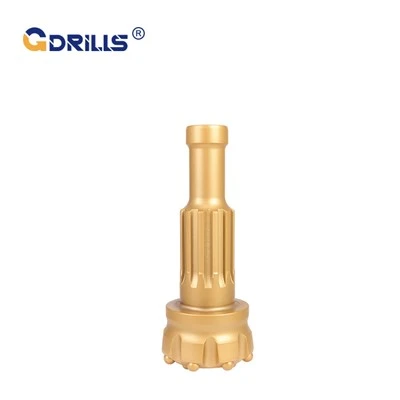
If you've ever seen a drilling rig churning away at a construction site, a mineral exploration spot, or even a water well project, you've probably noticed the long, sturdy poles connecting the rig's top hammer to the drill bit. Those are DTH drilling rods, and if you're in the market for reliable drilling gear, you should know exactly what they do-and why they're non-negotiable for efficient, safe drilling. Let's break this down like we would with a fellow contractor who's tired of rig downtime and subpar results, no stuffy industry jargon here.
First, let's keep it simple: DTH stands for "Down-The-Hole," which means the hammer that actually delivers the impact to break rock sits right at the bottom of the hole, not at the top of the rig. That's a game-changer, and the rods are the critical link between that down-the-hole hammer and the rig's power source. So their core purpose isn't just to hold things together-it's to transfer three key things: rotational force (so the bit can carve through rock), compressed air (which powers the DTH hammer and also flushes cut rock dust out of the hole), and impact energy (the heavy blows that pulverize hard materials like granite or basalt). If the rods can't do any of that consistently, your drilling project is going to stall fast.
Let's talk about why that impact energy matters most. Top-hammer drilling (the old-school way) puts force on the top of the drill string, which means some of that energy dissipates as it travels down the rods-by the time it hits the bit, you're wasting up to 30% of the rig's power. DTH rods eliminate that loss because the hammer is right at the hole bottom. For our customers, that means less fuel used, faster drilling, and less wear on the rig's main components. I've seen jobs where a crew switched from top-hammer to DTH rods and cut their drilling time in half on hard rock-no exaggeration. That's the kind of efficiency that turns a tight deadline into a smooth project.
Now, not all DTH rods are the same, and that's where your choice matters. We supply API 5DP DTH Drill Pipe for a reason-API (American Petroleum Institute) standards are the industry benchmark for consistent quality, so you don't have to worry about rods bending, cracking, or leaking air mid-drill. A lot of budget rods skimp on the material strength: they use thinner steel or bad welds, which leads to "string failures" right when you're 100 feet into a hole. That's a nightmare-you have to pull the whole string, inspect for damage, replace the bad rod, and lose hours of time. Our rods are heat-treated to handle the high torque and impact of DTH drilling, so those failures are almost unheard of for regular customers.
Another key purpose of DTH rods is to maintain the hole's integrity as you drill deeper. Every time you add a new rod to the string, you're creating a connection point-and if that connection isn't sealed tight, compressed air will leak out before it reaches the hammer. That's another efficiency killer: leaky air means the hammer doesn't hit as hard, and cuttings don't get flushed properly, which can cause the bit to get stuck in the hole (a "bit lock") and add even more downtime. Our DTH rods use precision-machined threaded connections with thread protectors (sold separately, of course) to keep that air sealed. I tell new customers to check the connection torque every 50 feet when drilling in hard rock-skip that step, and you'll regret it.
Wait, let's not forget about different application-specific needs. If you're drilling water wells, you need rods that can handle longer lengths (since wells are often 500+ feet deep) and resist corrosion from mineral-rich groundwater. For mineral exploration, you might need shorter, more flexible rods to navigate uneven rock formations. For construction drilling (like for foundation piles), you need rods that can handle high axial loads from the weight of the string itself. That's why we carry a range of DTH rod sizes and grades-we don't do a one-size-fits-all approach. If a customer tells us they're drilling in soft limestone vs. hard granite, we'll point them to the right rod, not just the one with the lowest price.

A common question we get is: can't I just use regular drill pipe instead of DTH-specific rods? Short answer: no. Regular drill pipe isn't designed for the constant, hard impact of DTH hammers. It's thinner, has weaker connections, and can't transfer compressed air at the same pressure. We've had a few customers try to cut corners with regular pipe, and within a week, they had three cracked rods and a damaged DTH hammer-costing them way more than if they'd just bought the right rods upfront. That's the kind of bad decision we try to prevent by being transparent about what each part does.
Now, let's talk about longevity-because that's a big part of a rod's purpose too. A good DTH rod should last for hundreds of hours of drilling, not just a few jobs. We use high-grade alloy steel (4140 and 4145, for those who care about the specs) because it's stronger than standard carbon steel and resists wear from the drill bit's rock abrasion. We also coat our rod bodies with a anti-corrosive, anti-wear finish that cuts down on rust and scuffs-especially useful for customers who store rods outdoors between jobs. A lot of our repeat customers buy 50+ rods at a time because they know our gear won't let them down, even in remote worksites with harsh conditions.
What about maintenance? The purpose of DTH rods also includes being easy to maintain on-site, right? You don't want to have to send every rod back to a shop to fix a thread or a small leak. Our rods have easy-to-clean threads, so you can wipe them down with a rag every time you pull them out, and a thread chaser kit can fix minor thread damage in minutes. We also keep replacement thread protectors in stock, so you don't have to wait days to replace a protector that got cracked on a job site. That kind of accessibility matters when you're working against a clock.
Let's tie this back to why our customers choose us. We're not just a DTH drilling rods supplier-we're a resource. A few months back, a contractor in Alberta called us panicking: their rods had failed mid-drill on a diamond exploration site, and they needed 20 new rods shipped overnight to make their deadline. We had them in our next-day LTL shipment, and not only that, we walked them through how to torque the new connections correctly over the phone. That's the kind of support that turns a one-time buyer into a customer who refers us to all their friends in the drilling game.
So, to wrap it up, the core purposes of DTH drilling rods are threefold: first, transfer the critical power (rotation, air, impact) from the rig to the down-the-hole hammer without wasting energy or losing force. Second, maintain the hole's integrity by creating secure, airtight connections and resisting the stresses of deep drilling. Third, stand the test of time with strength, corrosion resistance, and easy maintenance to keep drilling operations moving. If you're shopping for DTH rods, don't just look at the price-look at the quality of the steel, the connection design, and the supplier's track record. That's where we come in: we offer API 5DP DTH Drill Pipe that checks all those boxes, plus the support to make sure your drilling project runs smoothly.
If you're gearing up for a drilling project, or you've had enough of rod failures and rig downtime, let's talk. We can help you pick the right DTH rods for your specific job, answer any questions you have about compatibility or maintenance, and get your order shipped fast. There's no project too big or too small-from a 100-foot water well to a 1,000-foot mineral exploration hole, we've got you covered.
References
-
International Association of Drilling Contractors. (2022). Down-The-Hole Drilling Technology Handbook.
-
American Petroleum Institute. (2021). Specification 5DP: Drill Pipe.
-
Drilling Magazine. (2023). "Rod String Performance and Failure Prevention in DTH Drilling."
-
National Ground Water Association. (2022). "Drill Rod Selection for Water Well Construction."