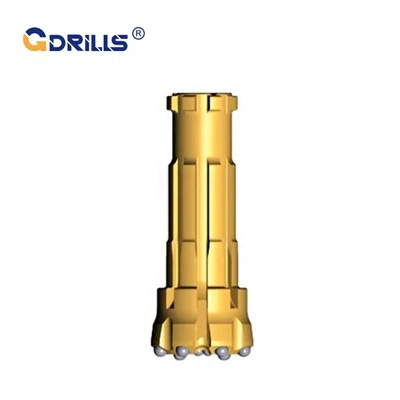
Torque is a measure of the force that can cause an object to rotate around an axis. In the context of DTH drilling rods, torque capacity refers to the maximum amount of rotational force that a rod can withstand without failing. When a drill bit is cutting through rock or other materials, it encounters resistance. The drill rig applies torque to the drilling rods to overcome this resistance and keep the bit rotating. If the applied torque exceeds the torque capacity of the rod, it can lead to a variety of problems, such as rod breakage, thread failure, or reduced drilling efficiency.
Factors Affecting Torque Capacity
Material Properties
The type of steel used in the manufacturing of the rods plays a significant role. High - strength steels with good ductility and toughness are preferred for DTH drilling rods. For example, alloy steels that have been heat - treated to achieve a specific hardness and strength can withstand higher torques. The chemical composition of the steel, including elements like carbon, manganese, and chromium, affects its mechanical properties. A well - chosen steel composition can enhance the rod's ability to resist deformation and failure under high - torque conditions.
Rod Dimensions
The diameter and wall thickness of the DTH drilling rod are important. Generally, larger - diameter rods have a higher torque capacity because they have a greater cross - sectional area. A thicker wall also contributes to increased strength and torque resistance. For instance, a rod with a larger diameter and thicker wall can distribute the applied torque more evenly, reducing the stress concentration at any one point.
Thread Design
The thread design of the DTH drilling rod is another critical factor. The threads are responsible for connecting the individual rods in a drill string. A well - designed thread can transmit torque efficiently from one rod to the next. Different thread profiles, such as API (American Petroleum Institute) threads, are designed to provide a secure connection and high torque - transmission capabilities. The pitch, depth, and angle of the threads all affect how well the rods can handle torque.
Determining Torque Capacity
Manufacturers use a combination of theoretical calculations and practical testing to determine the torque capacity of DTH drilling rods.
Theoretical Calculations
Engineers use principles of mechanics and materials science to calculate the torque capacity based on the rod's material properties and dimensions. For example, the torsional shear stress formula can be used to estimate the maximum torque a rod can withstand before yielding. The formula takes into account the polar moment of inertia of the rod's cross - section and the shear modulus of the material. These calculations provide a starting point for understanding the rod's theoretical torque capacity.
Practical Testing
In addition to theoretical calculations, practical testing is essential. Manufacturers conduct torque tests on sample rods to validate their theoretical predictions. These tests involve applying a gradually increasing torque to the rod until it fails. The torque at which failure occurs is recorded as the rod's torque capacity. Testing is usually done under controlled conditions that simulate real - world drilling scenarios as closely as possible.
Importance of Torque Capacity in Drilling Operations
The torque capacity of DTH drilling rods has a direct impact on the efficiency and safety of drilling operations.
Drilling Efficiency
If the torque capacity of the rods is too low for the drilling conditions, the drill will not be able to rotate the bit effectively. This can result in slow penetration rates, increased wear on the drill bit, and higher energy consumption. On the other hand, using rods with an appropriate torque capacity allows for smooth and efficient drilling, reducing the time and cost of the drilling project.
Safety
Rod failure due to excessive torque can be extremely dangerous. A broken rod can cause the drill bit to become stuck in the hole, leading to costly downtime and potential damage to the drilling equipment. In some cases, rod breakage can also pose a risk to the operators. Ensuring that the rods have a sufficient torque capacity helps to prevent these safety hazards.

Our DTH Drilling Rods and Torque Capacity
As a supplier of DTH drilling rods, we are committed to providing products with high - quality torque capacity. Our rods are made from premium - grade steels that have been carefully selected for their strength and durability. We use advanced manufacturing processes to ensure that our rods meet or exceed industry standards.
Our API 5DP DTH Drill Pipe is a prime example of our commitment to quality. It is designed with a robust thread system that provides excellent torque transmission. The dimensions of our rods are optimized to offer a good balance between strength and weight, allowing for efficient drilling operations.
We understand that different drilling applications require different torque capacities. That's why we offer a range of DTH drilling rods with varying torque ratings to meet the diverse needs of our customers. Whether you are drilling in soft soil or hard rock, we have a rod that can handle the job.
If you are in the market for DTH drilling rods, we invite you to contact us. Our team of experts is ready to assist you in selecting the right rods for your specific drilling requirements. We can provide detailed information about the torque capacity of our products and help you make an informed decision. Whether you are a small - scale drilling contractor or a large - scale mining company, we have the products and expertise to support your operations.