

In DTH drilling applications such as open-pit quarrying, mining operations, construction foundation projects, and water well drilling, many users focus mainly on drill bit diameter, thread connection, or compatibility with the DTH hammer. However, one critical factor is often overlooked - the shape design of tungsten carbide buttons.
As the primary cutting elements of a DTH drill bit, carbide buttons directly interact with the rock formation during drilling. Their geometry determines how efficiently impact energy is transferred into the rock, how quickly the rock is broken, and how long the drill bit can maintain performance.
What Are Tungsten Carbide Buttons on a DTH Bit?
Tungsten carbide buttons are manufactured from tungsten carbide powder and cobalt binder through high-pressure molding and sintering processes. They are then installed into the DTH bit body as the main rock-cutting components.
A DTH bit button can be divided into 3 types: center buttons, middle buttons and gauge buttons. Different button positions also have different functions. Center buttons mainly improve penetration efficiency, middle buttons perform most of the rock-breaking work, and gauge buttons protect the bit edge and maintain hole diameter.
Common types of DTH bit button shapes


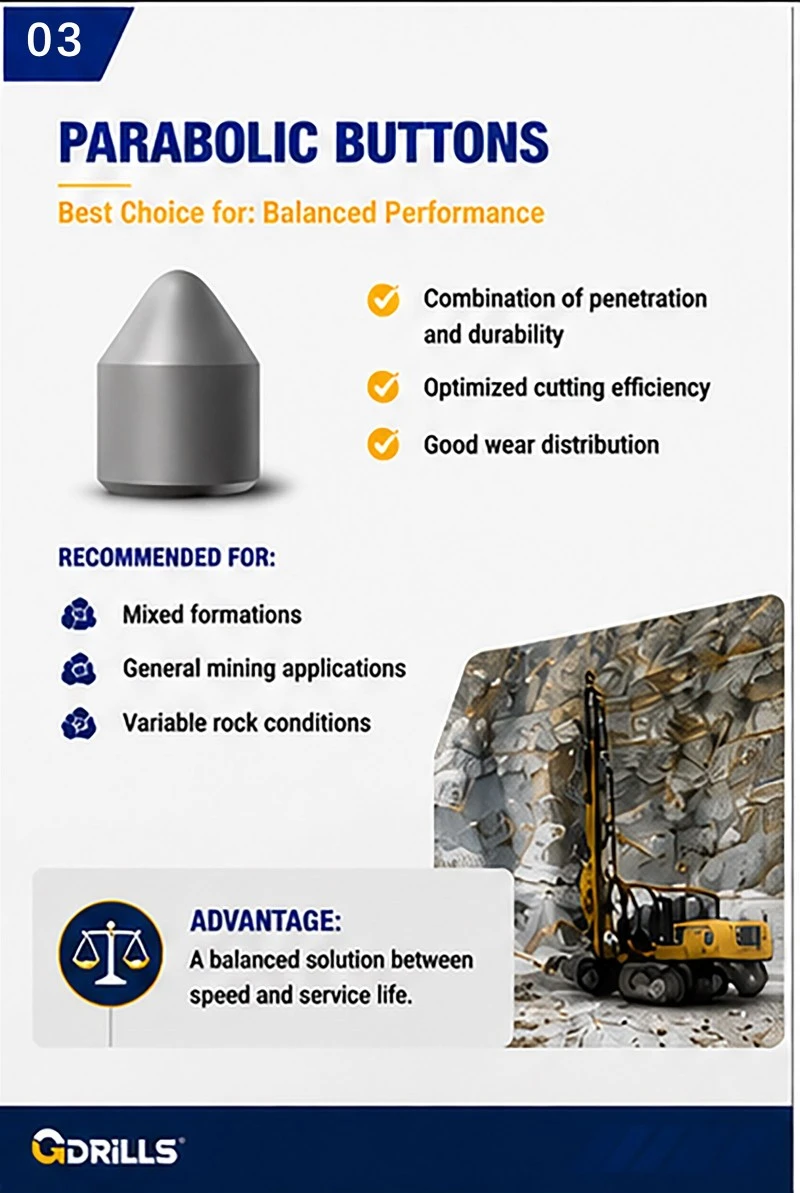

How to Choose the Right DTH Bit Button Shape?
Selecting the right DTH bit button shape starts with understanding the hardness and abrasiveness of the rock formation. Hard and highly abrasive rocks require button designs with stronger impact resistance and wear protection, such as dome buttons, which provide excellent durability in challenging conditions. For medium-hard formations, parabolic or ballistic buttons offer a better balance between penetration rate and service life. For softer rock formations, conical buttons can provide higher penetration efficiency due to their sharper cutting profile.
The ideal button shape is not always the one that delivers the fastest drilling speed. In mining and quarry operations, the key performance indicator is cost per meter, which considers drilling speed, bit lifespan, downtime, and replacement frequency. A more aggressive button design may increase penetration rate, but if it wears out quickly, the overall drilling cost can become higher. In many cases, a slightly slower but more durable DTH bit provides better economic performance over the entire drilling cycle.
Button position on the DTH bit face is also an important factor when selecting the right configuration. Center buttons are mainly responsible for initial rock penetration and improving drilling efficiency, while intermediate buttons handle the majority of the rock-breaking work. Gauge buttons, located on the outer edge of the bit, are designed to maintain hole diameter and protect the bit body from excessive wear. Therefore, gauge buttons usually require higher wear resistance and impact strength to ensure stable drilling performance and consistent hole quality.
GDRILLS provides professional DTH drilling solutions for mining, quarrying, construction, and water well applications. Based on different geological conditions, GDRILLS optimizes: Tungsten carbide button shapes, Carbide grades, Button arrangements, and Bit face designs. With customized DTH bit solutions and OEM/ODM capabilities, GDRILLS helps customers improve drilling performance and reduce overall cost per meter.

Choosing the right DTH bit button shape means better penetration, longer service life, and more efficient drilling. For professional DTH drilling solutions, visit: www.gdrills.net


